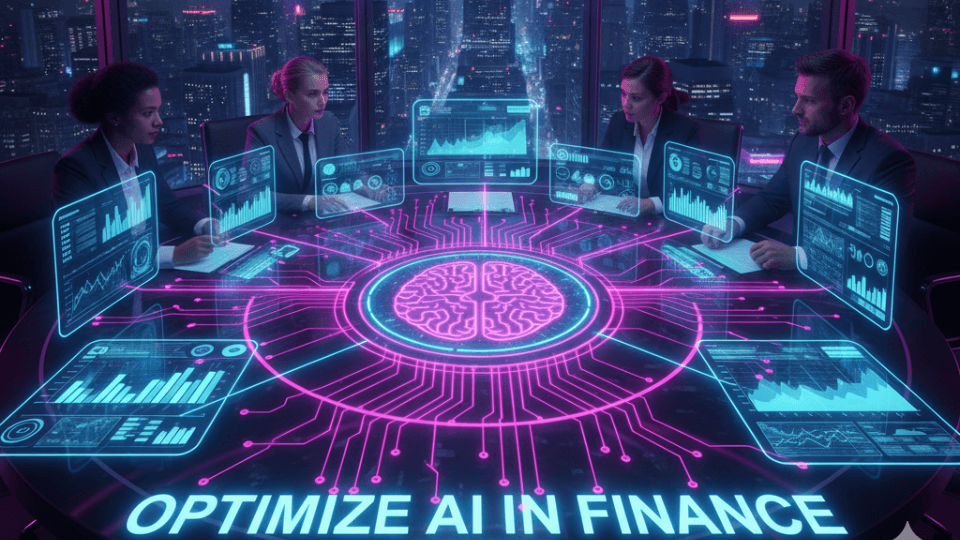
Optimize AI In Finance for Modern Teams
Imagine a financial operation where every prediction is sharper, every compliance check is flawless, and every customer interaction is perfectly tailored. The initial adoption of AI in finance has proven its value. Now, the imperative is to optimize these AI deployments, transforming them from helpful tools into indispensable engines that propel modern finance teams to unprecedented levels of efficiency, insight, and customer centricity. Optimizing AI isn’t just about technical fine-tuning. It’s about strategically leveraging intelligence to outperform competitors and redefine financial services.
Refining Predictive Analytics for Market Acumen
Initial AI applications in finance often provided basic predictive capabilities. Modern teams require more. Optimizing AI means refining predictive analytics to deliver unparalleled market acumen, giving financial professionals a decisive edge.
Advanced AI models can now ingest and analyze a far greater diversity of data sources, including alternative data sets (satellite imagery, social sentiment, news analysis) alongside traditional financial metrics. Optimizing these models involves continuous training with fresh data, using advanced machine learning techniques to detect subtle shifts in market sentiment, predict economic indicators with greater accuracy, and identify emerging investment opportunities or risks. Imagine an AI not just forecasting stock prices, but predicting the ripple effects of geopolitical events on specific asset classes. This level of refined predictive insight empowers modern finance teams to make faster, more confident investment decisions, manage portfolios with greater agility, and provide clients with truly superior advice.
Streamlining Compliance and Regulatory Reporting with Precision
Compliance is a non-negotiable, resource-intensive aspect of finance. While AI has begun to automate parts of this process, optimization means achieving a level of precision and speed that significantly reduces risk and liberates valuable human hours.
Optimized AI systems leverage Natural Language Processing (NLP) to continuously monitor the ever-evolving regulatory landscape, instantly flagging changes that impact an institution. These systems can automate the continuous auditing of transactions for suspicious activities, enhancing Anti-Money Laundering (AML) and Know Your Customer (KYC) protocols with unprecedented accuracy. By employing advanced anomaly detection, AI minimizes false positives that often plague traditional rule-based systems, reducing the burden on compliance officers. Furthermore, AI can automatically generate complex regulatory reports, ensuring precision and timeliness. This refined automation frees compliance teams to focus on strategic interpretation and complex investigations, rather than tedious, error-prone manual checks.
Personalizing Customer Experiences Through Intelligent Automation
Generic, one-size-fits-all financial advice and customer service are quickly becoming obsolete. Optimizing AI means fine-tuning intelligent automation to deliver deeply personalized customer experiences that foster loyalty and drive retention.
Advanced AI-powered chatbots and virtual assistants move beyond simple FAQs. They learn from every interaction, remembering customer preferences, financial history, and expressed goals. Optimizing these tools involves integrating them seamlessly with CRM and other customer data platforms, allowing them to provide highly tailored financial advice, product recommendations, and real-time support. Imagine an AI recognizing a customer’s specific spending patterns and proactively suggesting budgeting tools or savings options. This level of intelligent personalization creates a seamless, intuitive, and highly satisfying customer journey. It transforms customer interactions from transactional to truly relationship-driven, increasing engagement and reducing churn.
Optimizing Resource Allocation and Operational Efficiency
Back-office operations and resource allocation often contain hidden inefficiencies. AI, when optimized, becomes a powerful tool for revealing these bottlenecks and automating solutions, leading to significant gains in operational efficiency.
AI can analyze vast operational data sets to identify patterns of inefficiency, such as bottlenecks in loan processing, suboptimal resource deployment in accounting, or redundant steps in auditing. Robotic Process Automation (RPA), guided by AI, can then automate routine back-office tasks like data entry, document verification, and inter-system data transfers with greater precision and speed. This ensures human capital is deployed strategically, focusing on complex problem-solving and client-facing activities. By continuously learning from operational data, AI helps financial institutions dynamically optimize their workflows, leading to reduced operating costs, faster processing times, and a more agile overall operation.
Fostering Human-AI Collaboration and Continuous Learning
The most optimized AI in finance isn’t a standalone system. It is a seamless partner for human teams. Achieving this synergy requires fostering deep human-AI collaboration and establishing robust mechanisms for continuous learning.
Modern finance teams must be trained not just to use AI tools, but to critically evaluate AI outputs, provide feedback, and understand the ethical implications of AI decisions. Establishing continuous feedback loops is vital. Human experts should review AI-generated insights and recommendations, providing data that helps retrain and improve the AI models. This iterative process, where AI learns from human expertise and humans learn to leverage AI’s capabilities, ensures that the AI systems evolve alongside business needs and market changes. This adaptive approach guarantees that AI remains a valuable, optimized asset, empowering finance professionals to achieve superior results through intelligent teamwork.
Optimizing AI in finance is the strategic imperative for modern teams. By refining predictive analytics, streamlining compliance with precision, personalizing customer experiences, optimizing resource allocation, and fostering robust human-AI collaboration, financial institutions can unlock unprecedented levels of efficiency and insight. This commitment to continuous AI optimization will not only drive operational excellence but also solidify a leading position in the rapidly evolving financial landscape.
What is one specific AI-driven process within your finance operations that you believe has the most potential for further optimization?