Read the Room: Why College Grads are Boo-ing AI at Commencement
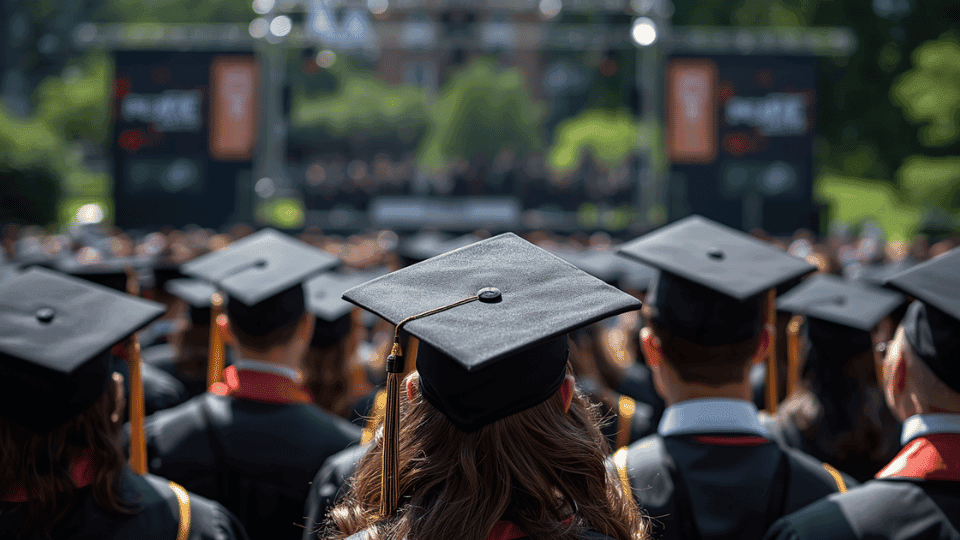
Graduation season is usually a time for celebration and hopeful speeches about the future. But in 2026, college speakers are running into a major roadblock. They are trying to get students excited about a world shaped by artificial intelligence, and the students are simply not buying it. Recent graduation ceremonies prove that the standard tech-hype speech is a quick way to get yourself booed off the stage.
Last week, Gloria Caulfield, a real estate executive, gave a speech at the University of Central Florida. She began talking about how we live in a time of profound change. When she called artificial intelligence the next industrial revolution, the crowd did not cheer. Instead, students in the audience started booing. The negative noise grew louder and louder until Caulfield had to stop and ask what happened. She tried to joke about it, saying that a few years ago AI was not even a factor in our lives, but the crowd drowned her out again with cheers and applause for the protesters.
The Backlash is Real
Former Google CEO Eric Schmidt faced an even harsher reception when he brought up the tech during his address at the University of Arizona. In his case, student groups actually petitioned to remove him before he even arrived on campus due to personal legal disputes. When he finally took the microphone, the boos started immediately.
Schmidt tried to push through his speech. He told the graduates they would help shape AI. He urged them to build teams of AI agents to accomplish tasks they could never handle alone. He even used an old Sheryl Sandberg quote, telling them that if someone offers you a seat on a rocket ship, you do not ask which seat, you just get on. The students remained unimpressed. The booing was so persistent that Schmidt had to raise his voice to finish his remarks.
Why Students are Angry
This hostile reaction makes total sense when you look at how young people view the economy right now. A recent Gallup poll showed that only 40% of people aged 15 to 34 think it is a good time to find a local job. That is a massive drop from 75% just a few years ago. Grads are looking at a job market where entry-level roles are shrinking because companies use automation to cut costs.
The anger is not just about a lack of jobs. It is about the cynical message tech leaders are pushing. Tech critic Brian Merchant pointed out that AI has become a cruel symbol of hyper-scaling capitalism. Grads who spent years studying and going into debt do not want to hear that a software model will replace their career path before it even starts. They do not want to be told to just enter prompts into a machine.
A Better Way Forward
Not every tech executive failed the test this year. Nvidia CEO Jensen Huang spoke at Carnegie Mellon University and managed to avoid the wrath of the crowd. Instead of lecturing students about how they must adapt to his technology, he focused on how AI has reinvented computing as a tool for human creativity.
Speakers who want to survive commencement season need to drop the generic corporate scripts. Caulfield lost her audience of arts and humanities graduates by praising tech billionaires like Jeff Bezos instead of acknowledging the students’ actual achievements. Another graduate, Alexander Rose Tyson, told reporters that the booing was a collective, organic expression of frustration. Students are entering a world facing a changing climate, fractured politics, and evaporating jobs. If you stand on a stage in 2026 and tell them that a chatbot is going to save them, you deserve to get booed.