The Memory Fix: How This Startup Raised $135M to Break AI’s Biggest Traffic Jam
Every single time you type a prompt into ChatGPT, you trigger a silent, invisible data race. Your request does not just process instantly in one spot. Instead, the underlying data has to leave the memory chips, travel through a central processor for preprocessing, move to a graphics processor for heavy math calculations, and then make the long journey all the way back. This exact round trip repeats for every single word the artificial intelligence generates.
This constant back-and-forth travel creates a massive structural bottleneck. It forces data to route through some of the most expensive and power-hungry chips in the tech ecosystem on every single request. This massive inefficiency is exactly what XCENA, a hardware startup with offices in South Korea and the United States, wants to fix. The five-year-old company designed a brand-new chip architecture that places processing capabilities directly next to the DRAM memory chips. By handling data operations right where the data lives, the company eliminates the costly, slow round trips between separate processors and memory units.
If this technology succeeds at scale, the savings for global cloud infrastructure could be massive. This potential has sparked immense excitement among technology investors. XCENA just secured $135 million in a Series B funding round, valuing the startup at $570 million and pushing its total funding to $195 million. Seoul-based venture capital firms Altinum and IMM Investment co-led the round, with participation from Corstone Asia, SBI Investment, and Mirae Asset Capital.
Smart Founders Tapping Samsung Roots
XCENA has the deep industry experience needed to tackle this hardware challenge. CEO Jin Kim co-founded the startup in 2021 alongside CTO Dongjin Kim and CPO Henny Junguk Kim. All three founders are veteran engineers from memory giants Samsung and SK Hynix, the very companies that supply the high-bandwidth memory powering Nvidia’s top-tier chips. Jin Kim points out that while processors have grown exponentially faster over the last few decades, standard memory architecture has remained largely unchanged. XCENA wants to pivot the industry toward memory-centric computing.
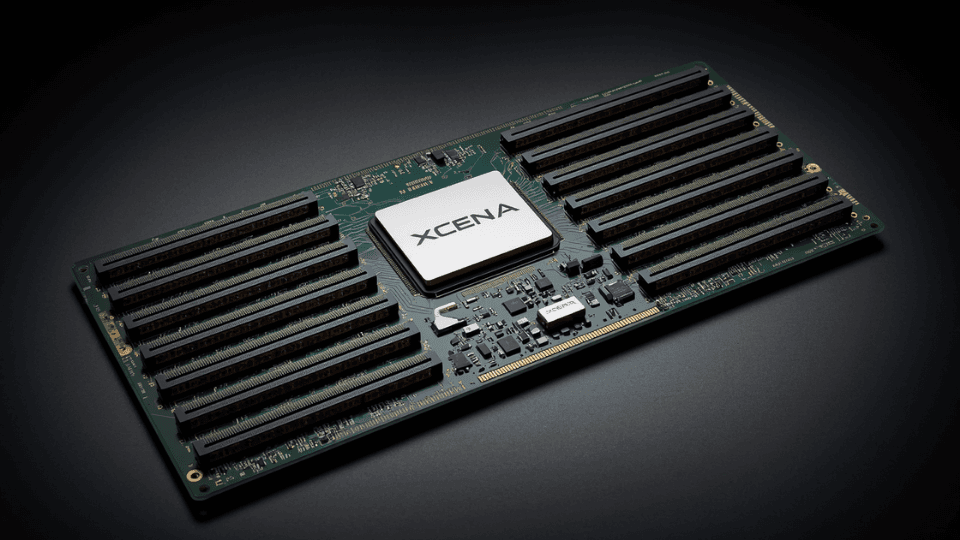
The startup is betting its entire business on a simple thesis: running AI models is fundamentally a memory scaling problem, not just a raw computing problem. The company’s prototype chip, the MX1, connects directly to a CPU using a specialized express lane called Compute Express Link. Instead of moving data to the processor, the MX1 brings the processing power straight to the data. The company claims this architecture is so efficient that it can compress the workload of ten traditional servers down into a single server unit.
Cutting Out the Noise
While high-end graphics cards excel at the heavy matrix multiplication required to train AI models, standard CPUs still handle the surrounding data organization. This includes preprocessing tasks, data caching, and key-value cache management, which stores previous conversation context so the model does not have to reprocess your entire chat history on every turn. XCENA’s chip handles these exact tasks inside the memory module itself.
The demand for efficient memory solutions has skyrocketed over the last year, and XCENA thinks its timing is ideal. The startup is targeting massive cloud operators who spend billions of dollars on data centers. For these giants, even a minor gain in hardware efficiency translates into hundreds of millions of dollars in savings.
While the MX1 remains a prototype for now, production chips are scheduled to roll off Samsung’s manufacturing lines by the end of 2026, with early revenues expected in 2027. XCENA faces stiff competition from major players like Marvell and fellow startup Axiom Labs, but Kim believes their massive library of custom, open-source RISC-V processing cores will give them a distinct edge in the market.