Desktop Inertial Ignition: Cambridge Heavy Industries Constructs Benchtop Fusion Reactor Using Precision Lasers
Cambridge, Massachusetts startup Cambridge Heavy Industries built a compact fusion device that fits on a standard laboratory tabletop. Speaking during a video interview, co-founder and chief executive officer Yun Kei gave a look at the compact hardware running inside a small testing facility near MIT. The startup raised $6.2 million in seed funding led by Azolla Ventures, with participation from Overlay, Neta Foundation, P3A, MassCEC, and the Rothrock family to advance its laser-driven fusion architecture.
Most global fusion experiments conjure images of massive industrial facilities housing giant superconducting magnets or stadium-sized laser arrays. Cambridge Heavy took a different path, deliberately designing a benchtop modular reactor that allows engineering teams to conduct experiments rapidly. The small modular design lets researchers execute 50 to 80 experimental shots daily, generating real-time operational data that feeds artificial intelligence simulations to optimize future reactor designs.
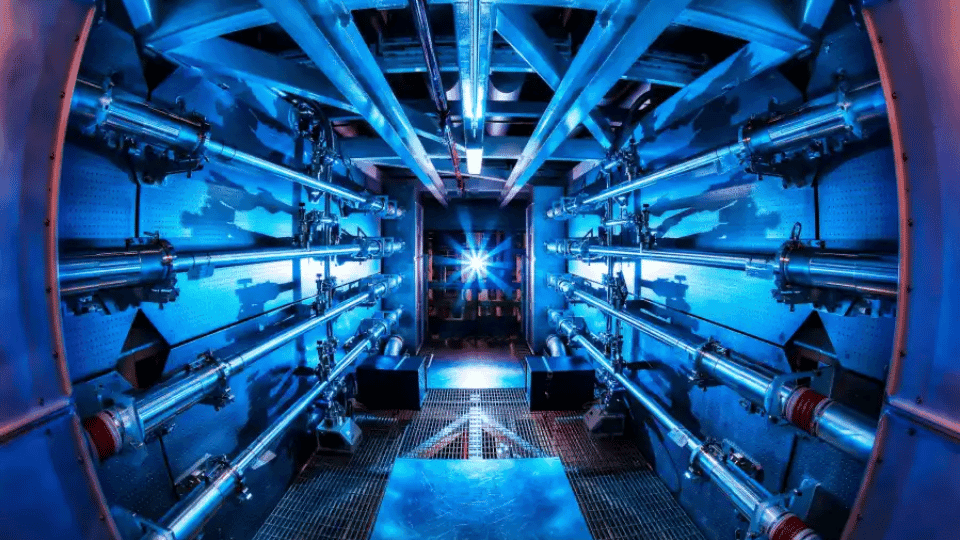
The underlying technology relies on laser-driven inertial confinement to compress fuel targets, similar to large-scale ignition experiments that produce net energy gains. However, Cambridge Heavy’s design minimizes the total number of lasers required to trigger fusion reactions. The setup fires two primary laser beams to drive target ignition. The system splits the first laser into multiple beam lines, delivering concentric rings of laser light that strike a flat, round fuel target from the outside working inward. This first ring creates an inward-traveling compression wave, while subsequent laser rings fire at precise microsecond intervals to boost the wave and compress the fuel target further.
When the compression shock wave hits the exact center of the fuel target, a second primary laser fires directly into the core, generating localized heat and an intense magnetic field. The intense pressure, heat, and magnetic force squeeze the fuel target until nuclear fusion occurs. Co-founder Yun Kei explained that the underlying concept originated inside the MIT research laboratory of chemist Keith Nelson, where scientists used short laser pulses to test material behavior under extreme pressure conditions.
Over the coming decade, Cambridge Heavy plans to scale up its benchtop concept into a commercial power plant prototype. While future commercial reactors will exceed the benchtop setup in size, the planned power plant will remain relatively compact, spanning an area roughly equivalent to two basketball courts. The medium-scale prototype will test whether the laser compression technique can generate sufficient electrical output to power municipal grids continuously.
Before building full-scale power facilities, Cambridge Heavy plans to generate early commercial revenue by producing tritium, a rare hydrogen isotope essential for operating modern fusion reactors. Global supplies of tritium remain extremely scarce, with current estimates showing only about 40 kilograms existing worldwide while market prices hold near $30,000 per gram. Recent market studies predict the global fusion industry will face a 28-kilogram tritium shortage by 2054, representing roughly $840 million in unmet fuel demand.
Producing tritium on smaller benchtop reactors gives Cambridge Heavy a commercial product to sell while full-scale power plants remain in development. Each commercial power plant requires only a few grams of tritium per year to run, but producing surplus fuel helps supply rival fusion startups building out their own reactor prototypes. Selling high-value fusion fuel provides years of steady revenue, giving the startup financial independence as it prepares its laser compression architecture for commercial power grid deployment.