Clinical AI Testing: Apple Launches Dedicated Study App to Track How People Use AI for Health
While rival AI labs like OpenAI and Anthropic race to launch consumer medical chatbots, Apple is taking a far more measured path. Instead of rolling out an automated health assistant to the general public right away, Apple introduced a dedicated research application designed to study how everyday users interact with and evaluate artificial intelligence for medical questions. By testing clinical answers in a controlled study environment first, Apple wants to measure how well clinically grounded AI tools actually help people manage their personal wellness.
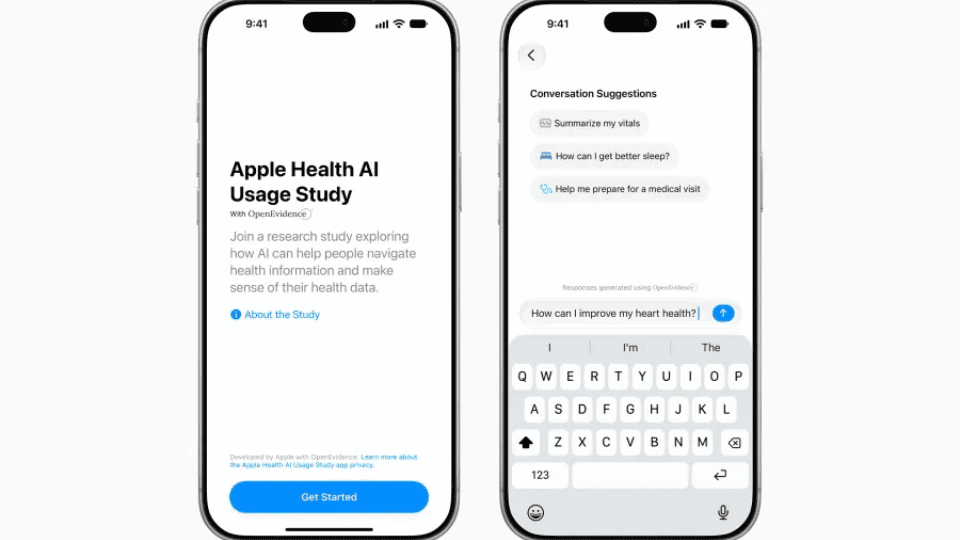
To power the clinical side of the study, Apple partnered with healthcare-focused AI firm OpenEvidence. The new research program, called the Apple Health AI Usage Study, is open to eligible participants across the United States. To join, users must be at least 21 years old, own an iPhone 15 Pro or newer device running iOS 26 or later, and have Apple Intelligence turned on. Apple aims to recruit up to 200,000 participants and expects the study to run for more than 12 months.
Inside the study app, participants can ask everyday health and medical questions just like they would inside general chatbots such as ChatGPT or Claude. However, instead of pulling answers from unverified web pages, the system generates responses grounded directly in peer-reviewed clinical literature, citing medical journals like The New England Journal of Medicine, the Journal of the American Medical Association, and Nature. Apple designed the app to translate complex medical findings into plain, easy-to-understand language. After reading each response, participants rate the answer for accuracy and usefulness, provide written feedback, and complete monthly follow-up surveys to help researchers track trust and comprehension over time.
Participants also have the option to share personal biometric records from Apple HealthKit, including resting heart rate, daily physical activity, sleep patterns, and uploaded lab results. Connecting personal health metrics allows the app to deliver tailored suggestions and generate structured summaries that help patients prepare for upcoming doctor appointments. When users ask questions involving serious symptoms, the software includes built-in safety guardrails that direct patients to consult qualified healthcare providers rather than attempting to diagnose conditions.
Strict data privacy protections sit at the center of the research framework. Apple confirmed that all user data is stripped of identifying details and anonymized before moving to a secure third-party cloud server. Company officials emphasized that study interactions will never be used to train external artificial intelligence models. Additionally, partner OpenEvidence automatically deletes all user questions and generated responses after 24 hours.
Sumbul Desai, Apple’s vice president of Health and Fitness, noted in an official announcement that personal health requires scientific rigor and clinical accuracy. Running a structured study allows Apple to observe how real people interpret medical AI answers in daily life before making broader product commitments.
The study app is available for download across the United States starting today, though Apple has not confirmed whether similar AI answering features will eventually arrive inside the native Apple Health app or Siri. With OpenAI recently reporting that users submit over 300 million health-related queries to ChatGPT every single week, consumer appetite for digital medical guidance is massive. Taking time to test clinical accuracy and user trust positions Apple to avoid the hallucination risks that plague general-purpose chatbots in high-stakes healthcare scenarios.