Context Everywhere: Superhuman Pushes Its Go AI Assistant Into Every Corner of Your Workspace
Software productivity suites are racing to feed deeper workplace context into their artificial intelligence tools while embedding those assistants inside every window users open. Superhuman, the company formerly known as Grammarly, is pushing hard in that direction with a sweeping rollout of upgrades centered around a personalized Go assistant, native agents inside Docs, and dozens of third-party software integrations.
Although several of the company’s earlier AI features drew criticism from users, Superhuman began aggressively promoting its Go assistant after rebranding last year. With this latest release, Superhuman is teaching Go to pull context across separate apps and deliver tailored prompt suggestions automatically. To make that context useful right away, the company redesigned its onboarding flow so new users can connect their favorite workplace tools and load background details about their projects up front.
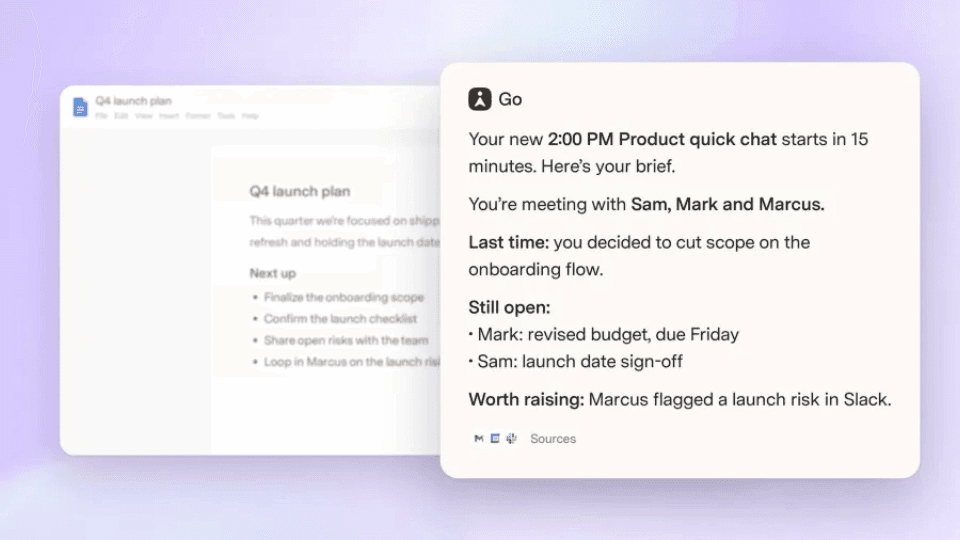
Inside daily workflows, Go operates inline right next to your cursor like classic Grammarly while also coordinating other specialized software agents. Superhuman is upgrading Go to behave proactively rather than waiting for manual prompts. The assistant monitors your calendar schedule, watches incoming emails, and prepares draft replies automatically. The updated Go agent also studies your personal writing voice over time and adapts its tone accordingly across both email threads and long-form documents.
To broaden what Go can access and control, Superhuman is adding 20 new connected agents, including DeepL, Legora, Amplitude, Databricks, and Blackboard, powered by its Go SDK. At the same time, the company is embedding Go directly across its core product lineup, including Docs and Superhuman Mail. Inside Docs, all Go agents run natively, allowing users to dispatch automated tasks in the background or set up event-driven routines that trigger multi-step workflows automatically.
Inside Superhuman Mail, Go is replacing the older central AI tool to serve as the primary intelligence layer. Users can run enterprise searches across internal company knowledge bases and connected apps directly from their inbox. Go then applies that organizational context to write email drafts and sort messages across both Google Workspace and Microsoft Outlook accounts.
Superhuman also folded in technology from Fathom, the AI meeting notetaker it acquired in September, to capture spoken context from video calls. The suite now rolls out live collaborative notetaking that teams can share in real time. Better yet, Go turns meeting transcripts into immediate action items after a call ends, such as generating the initial draft of a client proposal based on what participants just discussed.
Superhuman Chief Executive Officer Shishir Mehrotra told TechCrunch that Go has gained strong traction, reaching more than one million active users. As a crowded wave of AI assistants competes for user attention across both personal life and office work, Mehrotra argued that while Go leans primarily toward professional productivity, it still handles personal emails and family schedules smoothly. He noted that modern assistants succeed when they treat users as whole people rather than drawing strict walls between personal tasks and office inboxes.
While Go does not compete directly with consumer social tools like Instinct, Muse, or Fe, Superhuman clearly wants knowledge workers to pick Go over workplace rivals like OpenAI’s Dots or Claude Duet. By wiring calendar awareness, meeting transcripts, email triage, and third-party enterprise data into a single cursor-level assistant, Superhuman is betting that deep cross-app context will win the daily productivity battle.